


How to Get Started in Robotics without a Degree: A Complete Beginner’s Guide
Introduction
Have you ever dreamed of building robots — but wondered if you needed a degree to get started?
Good news: you don’t. You can dive into robotics right now with curiosity, the right resources, and hands-on practice. This guide will take you from zero experience to building your first robot and beyond.
What Robotics Really Is — And What It Isn’t
Robotics blends electronics, mechanics, programming, and problem-solving. It’s creative and technical — and you don’t need formal schooling to start learning any of these skills. There are many paths within robotics:
- Hobbyist / Maker – Build fun robots at home
- Technician – Install, maintain, and troubleshoot robots in factories
- Developer – Write code that makes robots move and think
- Engineer – Design and optimize robots from the ground up
Each path values real skills and projects, not just degrees. The real question you need to ask yourself is: How interested in robotics am I?
How Interested In Robotics Are You?
To get started in robotics, you’ll obviously need an interest in robotics. No one achieves success in anything they attempt without first having an interest in what they do.
Not only interest — you’ll need the drive to do the work to get knowledgeable about the domain of robotics, and you’ll need a can-do attitude.
There’s a lot involved in learning robotics. Having the ability to lower your ego, to embrace your ignorance on subject material, and to have the discipline to put forth the effort to learn the basics will take you far in your journey in robotics.
Your Path to Success
Again, you don’t need a degree in robotics to start doing or learning robotics. All you need to get started in robotics — right now — is to have:
1.) An interest in robotics:
If you think you need an extensive background in electronics, mechanics, physics, mathematics, and computer programming to get started in learning robotics, you my friend are mistaken. Having some sort of knowledge in these are beneficial, but not absolutely necessary to get started in learning about robotics, for sure. We’ve all got to start somewhere and that somewhere begins with an interest in robotics — a path to get you started.
2.) A drive to start learning/doing robotics:
Having an interest in robotics is one thing, but to learn and do robotics is another. If you have an interest in robotics, the next step in learning robotics is to have the drive to take action to learn more about them and how to build them. You won’t obtain much success if you don’t have that drive. If you don’t have the drive, then your interest subsides. If your interest subsides, then you’ll never learn much about robots, nor learn how to build them — this is a path to nowhere.
3.) A can-do attitude:
One of the saddest things in this world is when someone doesn’t believe in themselves enough to even try something. Learning robotics may seem intimidating and it may feel overwhelming to push through that mental blockade that prevents us from getting started, but know you can do it. That’s exactly what you need, a can do attitude — a big step toward the path of robotics.
You’ve seen how cool robots look in movies and TV. You’ve seen the news depict them as future helpers in industry. You are on the artificial intelligence bandwagon and think it would be awesome to someday see sentient robots walking among us. You’ve fantasized to someday build your very own robot to do things like:
- pick up your messes,
- notify you when someone is at the door,
- to mow your lawn,
- to guard your home day-and-night,
- or to do simple, meaningful things like be a companion or a pet.
Whatever your interests are in robotics — whatever your heart’s desire is in wanting to learn robotics, this beginner’s guide will steer you on the right path on how to learn robotics without the need of obtaining a degree.
6 Steps to Getting Started in Robotics — Your Path to Success
🔎 Step 1: Discover Your Why
Before you begin, ask yourself:
- Do you want to build robots for fun?
- Do you see yourself working in industry?
- Are you curious about programming, mechanics, or AI?
Your motivation will shape your learning path.
📘 Step 2: Learn the Core Skills
Here’s what beginners should focus on first:
- 🔌 Basic Electronics: This one is very important. Understanding circuits, sensors, and motors helps you build things that move and sense the world.
- 💻 Programming Languages: This one is not as important in the beginning of your learning, but is important when you become a little more advanced in your skills. When you’re ready, learning just one of the following programming languages is enough to start:
- Python — beginner-friendly and widely used
- C/C++ — core language for embedded systems
- Arduino — perfect for physical computing
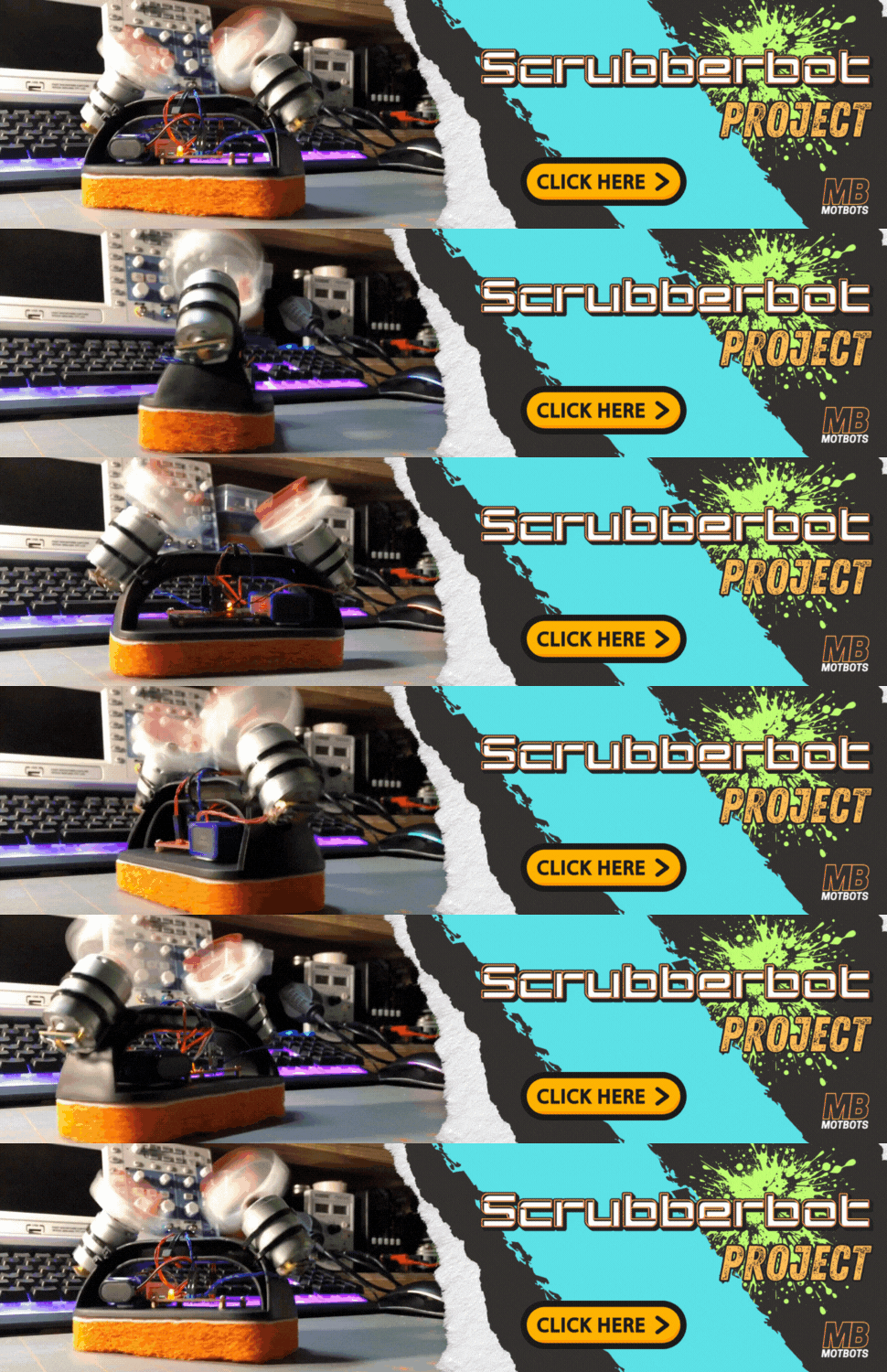
- 🛠 Build Real Projects: Theory is great — but people learn fastest by doing. Some common beginner friendly robot projects are:
- Line-following robot
- Echo-sensor obstacle avoider
- Bluetooth-controlled rover
- Simple robotic arm
- Scrubberbot
Use kits or scavenged parts — don’t wait for perfect tools.
📚 Step 3: Read Books, Magazines, and Blogs
Delve deep into the electronics, robotics, and programming by reading books, magazines and blogs. Some recommended books include:
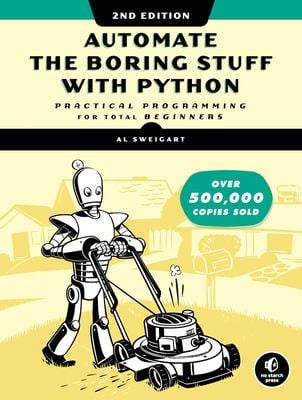
- Automate the Boring Stuff with Python, by Al Sweigart
- Robot Building for Beginners, by David Cook
- Robot Builder’s Bonanza, by Gordon McComb
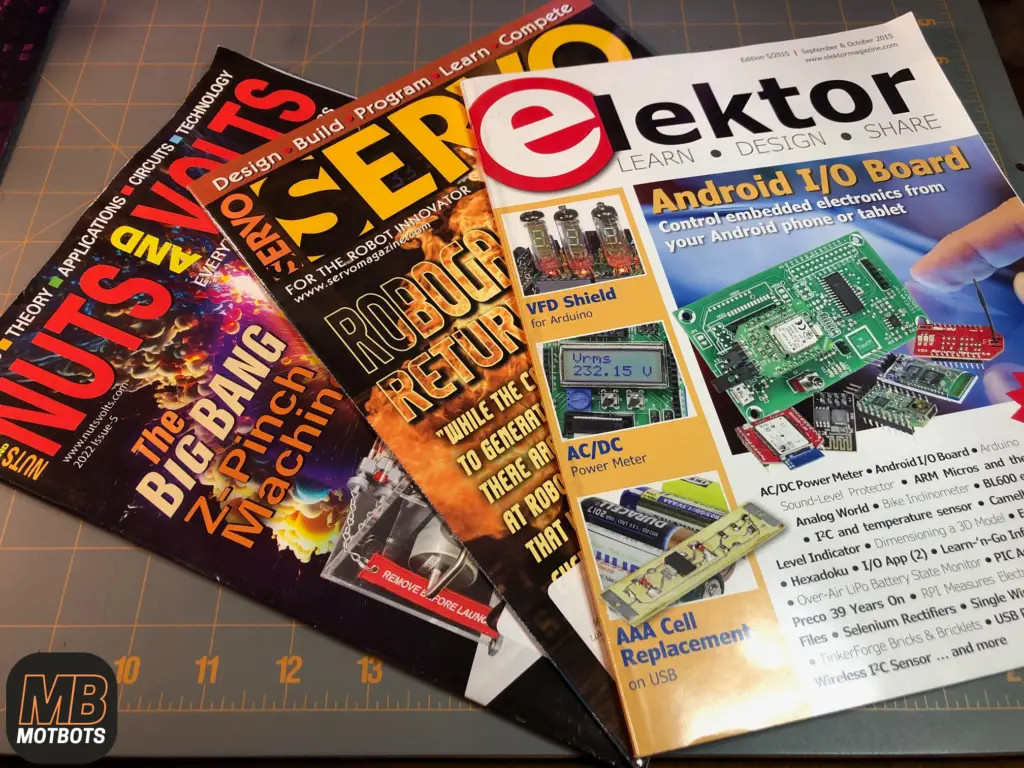
There are still magazines available for subscription out there, like:
- Nuts and Volts,
- Servo, and
- Elektor
which offer lots of great articles on electronics and robotics, as well as provide DIY projects.
Blogs like Motbots, RobotShop or Dronebot Workshop offer insightful articles and resources on robotics and electronics, as well.
👩💻 Step 4: Use Online Courses & Tools
The internet has amazing free and low-cost resources:
- YouTube: YouTube offers a plethora of video content on robotics. There are many great content makers that do everything from talk about robotics to teach you how to build your own. Some great content makers that give advice on getting started in robotics are:
- Liz’s channel, Learn Robotics and
- Sina’s Robotix with Sina.
- Content creators who are more hands-on in teaching you robotics are:
- Bill’s Dronebot Workshop and
- Paul’s channel — Paul McWhorter.
You may even want to check out our channel for hands on learning from our project material here on our website, where we do all sorts of electronics and robotics projects.

- Online Courses: There are many online courses and tutorials that you can take advantage of online. Many free courses and tutorials are on YouTube, such as:
- Paul McWhorter’s Introduction to Robotics and Robots for Beginners Tutorial,
- Stanford’s Introduction to Robotics, and
- Northwestern Robotics’ course on Modern Robotics.
There are many other formats to take courses on robotics such as:
- edX
- Coursera, and
- Udemy
Each provides some free courses and material, but there are paid courses as well — for a small fee.
If you feel that you don’t have the resources to pay for courses, then you’re in luck! Everything Motbots provides in learning material on electronics and robotitcs on our website is freely available for you to use. Think of motbots.com as your personal workshop and/or library to come to when you’re ready to do some projects or learn something new.
- Experiment with Kits: Start with beginner-friendly robotics kits that provide step-by-step instructions and all the necessary components. These kits often include pre-designed robots that you can assemble and program yourself, allowing you to gain practical experience in building robots. Some great robot kits can be found at places like:
- Jameco.com in their Jameco Robot Store. Their customer service is excellent.
- Robotshop.com has a great variety of robotics projects and supplies. They also have excellent customer service.
- You can also find a great variety of kits at MakerShed.com, where there are many things to get you started in learning robotics and electronics.
If you’re in a location that doesn’t offer much in terms of finding local meetups or the ones closest to you are too far away, try to develop your own meetup and spread the word. You never know — there might be people close by who have the same interest in robotics as you who also wish to meet with like minded people.
- Free Simulators: Robotics and/or electronics as hobbies or otherwise, can be quite costly. A great way to get started in robotics without needing the funds to buy equipment, tools, parts, and components is to use a free (open-source) simulator, like Webots. Webots lets you program robots without hardware. It’s a multi-platform desktop application used to simulate robots, and it provides a complete development environment to model, program and simulate robots.
🤝 Step 5: Join Communities
Attend robotics workshops and meetups, or create one of your own: Search around via Google, Meetup.com, or even Facebook for local robotics workshops and meetups in your area. These types of events provide opportunities to:
- learn from experts,
- allows you to participate in hands-on activities,
- and allows you to network with other robotics enthusiasts.
Learning alone is hard — learning with others is fun and fast.
- Participate in meetups or hackathons
- Join online groups on Reddit, Discord
- Compete in beginner robotics competitions like Botball or programs from RoboNation.

📂 Step 6: Build a Portfolio That Matters
Without a degree, your portfolio is your resume. Document everything:
- GitHub repos
- Blog posts explaining projects
- Videos demonstrating robots in action
This shows employers *what you can do — not just what you *studied.

💬 A Few Words of Reality
Some career paths — especially in advanced research or high-level robotics engineering — do still expect degrees. But many others — like technicians, hobbyist designers, and even developers — reward real skills, experience, and passion. So, don’t give up your dream of getting into robotics. You CAN do it!
🏁 You Can Get Started Today
Don’t wait for perfect circumstances. Grab a cheap kit, open a textbook or beginner video, and start building. Even small robots can teach big lessons.
Robotics is a journey — and it starts with curiosity and action.
Where to Go From Here?
Start by reading books on electronics, robotics, and a programming language to learn the basics of each concept. Try buying used books if you can. They’re much cheaper than buying new books. Great places to search for used books on robotics is at:
- ThriftBooks.com,
- BetterWorldBooks.com, or even
- eBay
Absorb as much content on robotics as you can. YouTube contains an enormous amount of video content on robotics – like our Motbots YouTube channel! Try out the many free courses available on YouTube from small content creators to well know universities like:
- Stanford,
- IIT Kharagpur,
- or even MIT!
Get Started by making a simple robot. The best way to really learn something new is by getting your hands involved by making something of your own. You don’t have to start out with anything complicated, you can start off with something as simple as this robot project here.
Try to meetup with other like minded people who have similar interests as you in robotics. Having people you can talk to about robotics, as well as possibly build robots with makes the experience of robotics all the more worthwhile and fulfilling.
✅ Beginner Robotics Checklist
To help get you started on your robotics journey, I’ve created a free downloadable Beginner Robotics Checklist. Download it and keep it at your workbench to help guide you.
Final Thoughts
Getting started in robotics without a degree can feel overwhelming at first, but every maker, builder, and engineer begins in the same place — with curiosity and a willingness to try.
You don’t need perfect tools, formal credentials, or a clear end goal to begin. What matters most is taking that first step, experimenting, making mistakes, and learning from them.
Robotics is best learned with your hands on the workbench, one small project at a time. Whether your goal is to build robots for fun, explore new skills, or grow toward a future career, each project you complete builds real experience and confidence.
At Motbots, we’re learning right alongside you — exploring electronics and robotics one project at a time. So, keep at it and stay motivated. There’s always room at the workbench.

