
Electronics is the foundation of everything we build, experiment with, and explore here at Motbots. From the smallest components to complete circuits and control systems, this section brings together the topics that help us understand how electricity can be measured, guided, and put to work. Whether you’re just getting started or continuing your learning journey, there’s always something new to discover at the workbench.
Circuit Component Super Series
An NEW anticipated 12 part series on everything from the basics of circuit components to creating an intelligent robot (and everything in between).
Astable Multivibrator Subseries
A special three part sub-series to Part 3 of the Circuit Component Super Series.
Embedded Intelligence Series
A special anticipated seven part sub-series to Part 5 of the Circuit Component Super Series.

Diodes
A diode is a two-terminal electronic component that allows electric current to flow in only one direction. You can think of a diode as…

Solenoids
What is a Solenoid? A solenoid is a type of electromagnet that consists of a helical coil of wire. Its length is…

MOSFETs: 12 Essential Questions Answered
The Metal-Oxide-Semiconductor Field-Effect Transistor (MOSFET) plays a pivotal role in countless applications in electronics ranging from…

MOSFETs: Key Concepts and Practical Examples
Let’s talk about a specific type of field-effect transistor (FET); the Metal-Oxide Semiconductor Field Effect Transistor.

DC Motors
What is a DC Motor? A DC motor (Direct Current motor) is a device that converts electrical energy into usable mechanical energy, such as with its rotational energy.

Transistors
What is a Transistor? A transistor is a semiconductor device that serves as a fundamental building block in modern electronics. It is primarily used to…

Resistors
Have you ever wondered how electricity goes into your electronic device, swirls around in there, and does something useful? Maybe you’ve thought to yourself, can I control that electricity?

Kirchhoff’s Voltage Law (KVL)
Introduction Kirchhoff’s second law deals with the conservation of energy around a closed loop series path. We call this law Kirchhoff’s Voltage Law, or KVL, for short.

Kirchhoff’s Current Law (KCL)
Introduction Kirchhoff’s first law deals with the conservation of charge entering and leaving a junction. We call this law Kirchhoff’s Current Law, or KCL, for short.

LEDs
What Is an LED? The simple answer is that an LED is a type of light. It’s also a type of diode. The acronym LED stands for Light Emitting Diode. Just as a diode is…

Ohm’s Law
Ohm’s Law is one of the most fundamental principles in electricity and electronics, and it’s what helps us to describe the relationship of the current through a conductor between…
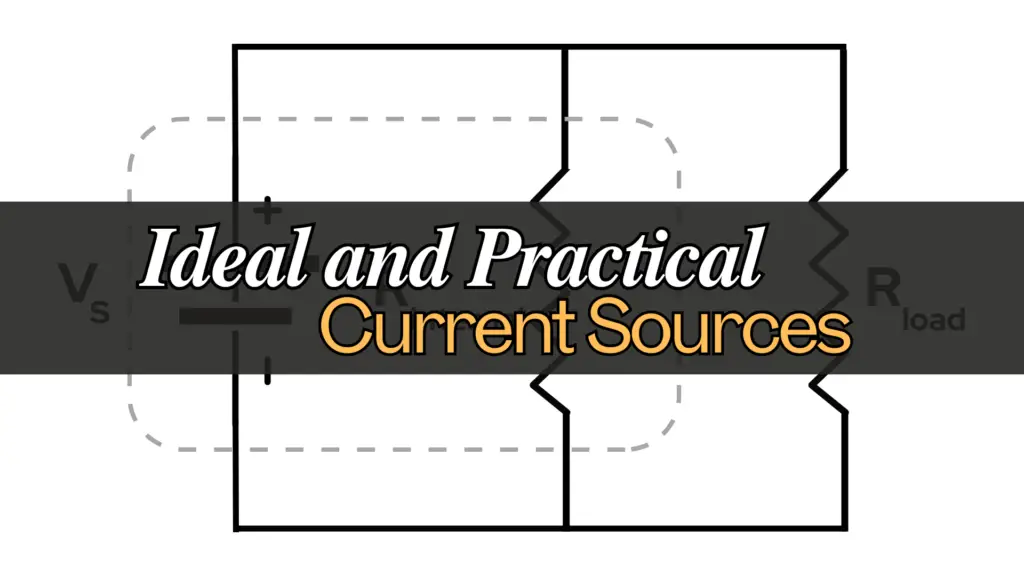
Ideal and Practical Current Sources
An ideal current source is a source of constant current to a system, independent of the source voltage. An ideal current source provides this constant current with…

Ideal and Practical Voltage Sources
An ideal voltage source is a source of constant voltage to a system, independent of any fluctuations of current. An ideal voltage source provides this constant voltage with…

Intro to Circuit Elements, Branches, Nodes, Loops and Meshes
A circuit element refers to a basic component that is used to construct electrical circuits. The element can be a physical device or an abstract concept that exhibits specific electrical…

Active and Passive Elements
Recall that a source is any device that delivers energy into to a system. A source is a device that actively generates electrical energy, such as a battery — whereas, an electrical load is…

Electronic Switches
A switch in electronics is a device or component that completes a circuit electrically. Electronic Switches An electronic switch is a switch that has no physical contacts or moving parts — like an electromechanical switch — that is operated by…

Electromechanical Switches
A switch in electronics is a device or component that completes a circuit electrically. An electromechanical switch is a switch that uses a mechanical action that physically manipulates contacts on…

Series Circuits
For a circuit to be considered a series circuit, circuit elements within the circuit must have a direct path, each joined in sequence — and the current path never forking, branching or splitting off into…

Multimeters in a Nutshell
A multimeter is a testing device that measures electrical properties and provides readouts of values pertaining to the electrical property being measured. The multimeter is a tool used by…
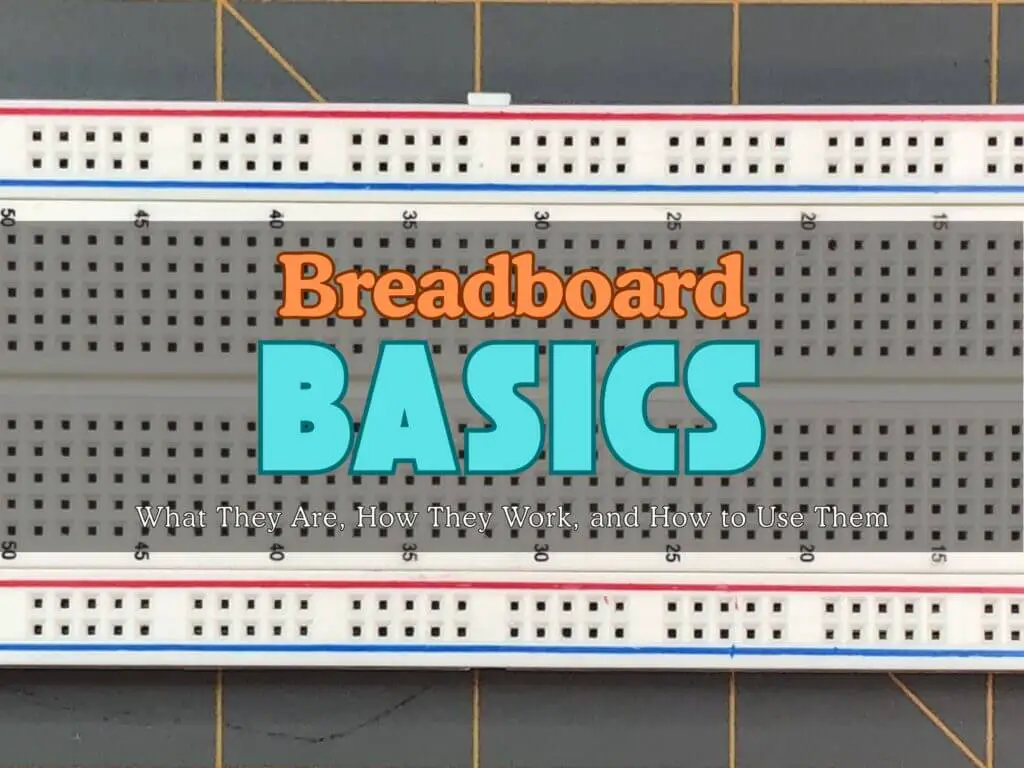
Breadboard Basics
If you’re new to the world of electronics, you might have seen a funny looking thing that is used extensively in the electronics community. It has no batteries, no doo-dads, buttons or cords. On its own it is…

How to Make a Simple Switch Circuit
In this project, we’re going to make the basic and simple switch circuit. Having a switch in your circuit allows you full control of your circuit. A switch allows you to turn ON or turn OFF the…

What is a Circuit?
Take a moment to think about any electronic device or piece of equipment containing electronics. There’s the coffee pot you use every morning, a smartphone you carry around in your pocket, the computer you use for work, a…