
What Is a Component? The Tiny Parts That Make Up Every Circuit
Introduction
The following is Part 1, of a planned 12 part super series on the topic of components – starting with what components are, then progressively working through more topics and ideas of components, further advancing these ideas into a robot project to really get you to understand how they work together to create something awesome and useful.
The following is how this 12 Part Super Series on Components will progress, in order:
- What Is a Component? (⬅️ YOU ARE HERE)
- Understanding Circuit Symbols and Schematics
- How Components Work Together in Real Circuits
- Putting Components to Work
- Introducing Microcontrollers
- Smart Circuits Meet AI
- Teaching Robots to Move
- How Sensors, Data, and AI Create Perception
- Human–Robot Interaction
- Decision Making and Autonomy in Robots
- Robotic Navigation
- Distributed Robotics, Swarms, and Multi-Agent Intelligence
Let’s get started with Part 1: What is a component?
What’s a Component, Anyway?
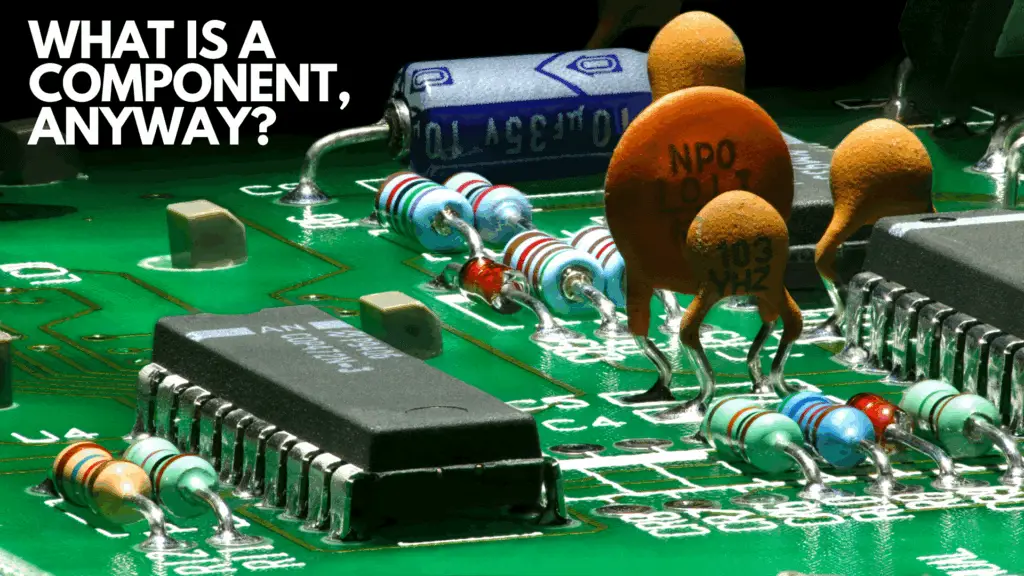
If you’ve ever been curious enough to crack open a TV remote or peek inside a computer, you’ve probably stared at a mysterious green board sprinkled with tiny dots, stripes, and blobs. No, that’s not one of Mom’s Christmas ornaments hidden in there, you’re looking at electronic components!
If electronics were a band, components would be the musicians. Each one plays a very specific instrument, but together they create the symphony of modern technology. Without them, your phone would be an expensive paperweight, your TV would be an awful art piece, and your coffee maker wouldn’t even hum a note.
So, grab yourself a cup of coffee (if you haven’t taken your coffee maker apart yet), and let’s dive into the world of components — what they are, what they do, and why they deserve a standing ovation.
🧩 Components: A Gourmet of Items That Make Up Every Circuit
In the simplest terms, a component is any electrical device that performs a specific function in a circuit.
Think of a circuit like a recipe — the components are your ingredients. Each one adds its own flavor: resistors provide balance, capacitors add zest, and transistors? Well, they’re the spice that makes everything exciting.
Like baking a cake with just one ingredient wouldn’t fulfill your appetite, trying to make a circuit with just one type of component wouldn’t get you a mixer to make you a cake (it’ll probably just short-circuit your sweet tooth).
Components come in two main varieties:
- Passive components: These just sit there doing their jobs quietly — like resistors, capacitors, and inductors.
- Active components: These need power to do their thing, like transistors, diodes, and integrated circuits (ICs).
Whether passive or active, each component plays its role in keeping the current flowing smoothly — or deliberately slowing it down, charging it up, or changing its direction.
If you want a cake, you need more than just one ingredient. If you want a mixer to make that cake, it’ll need a gourmet of electronic components that make up that machine to do what it’s meant to do – mix.
⚡ The Classics: Components That Have Withstood the Test of Time
Now, let’s get in the groove and listen in on the classics of the electronics world. Each of these little guys has a distinct personality — and yes, we’re giving them personalities, because they’ve earned it. If they each had their own album, the following would be their title to it:
Resistor – Slow and Easy Wins the Race
The resistor is like that one friend who is always cool-headed and suggests that everyone “just calm down.” If a resistor were like this friend, it’d always be insisting that there’s no need to rush – that you’ll get to where you’re going eventually.
Electric current wants to rush through a circuit like kids at a theme park — but resistors step in and say, “Whoa, whoa, whoa! Slow down, folks. Slow and easy wins the race!”
Resistors limit the flow of current so things don’t burn out or explode in tiny, dramatic fashion. They’re the traffic cops of electronics, keeping order and protecting sensitive components from too much current.

Capacitor – Short-Term Memory

The capacitor is like that unassuming person you see on a TV game show, that once they win and are asked to “come on down,” they explode in a burst of energy and excitement. Of course, that energy is short term, and when they loose the round that energy is immediately depleted from them. It’s like that burst of excitement they had earlier was a short-term memory.
Capacitors store electrical energy for a short time and release it when needed — like holding your breath before blowing out candles. They help smooth out power delivery, filter signals, and even act as little batteries in some cases.
In everyday life, capacitors are the reason your camera flash fires instantly or your computer stays on for half a second after unplugging. Basically, they’re the caffeine shot that keeps circuits peppy.

Inductor – Strong, Silent Type

Think of inductors like that guy who’s the strong silent type. If something is going on around him, he may be slow to react, but once he does, it’s like a lion released from its cage and you best be sure that everyone is aware of him.
Inductors are coils of wire that store energy in a magnetic field. They’re like springs for electricity — slow to react, but powerful once they do.
When current flows through an inductor, it builds a magnetic field; when that current changes, the field resists the change. That’s why inductors are used in filters, transformers, and motors — places where magnetic magic matters. They’re quiet, patient, and a little mysterious — the strong, silent types of electronics.
Diode – One-Way Street

If you’re familiar with messing around with water and water pipes, you can think of a diode as sort of a check valve or one-way valve for electric current – electricity can go in one direction only.
Said another way, diodes allow current to pass one way, but not the other. It’s like a one-way street for electrons.
Diodes are essential for converting AC (alternating current) to DC (direct current), protecting circuits from reverse voltage, and powering LEDs (which are basically diodes that glow when happy). Without diodes, your power supply would be as confused as a GPS in a cul-de-sac.
Transistor – Superstar

If components had celebrities, the transistor would be the Elvis of electronics. If the crowd was current, the transistor controls it.
Transistors can act as amplifiers (making signals stronger) or switches (turning things on and off at lightning speed). They’re the foundation of digital logic — and the reason your phone, laptop, and even your toaster’s brain can think. They made computers possible, shrunk radios to pocket size, and basically launched the Information Age. All that power from a component smaller than a flea? That’s superstar behavior, man.
LED – Stealing the Spotlight

Ever heard of a diva? Well, the LEDs (Light Emitting Diodes) are the divas of the electronics world. Feed them some electricity, and they’ll literally light up the room. If you don’t, they get hangry and will shutoff, leaving you in the dark.
LEDs come in all colors, use minimal power, and last forever. From the tiny indicator on your charger to massive billboard screens, LEDs are everywhere. You could say LEDs are the only components that really know how to steal the spotlight.
Well, there ya have it — you’ve just met the most common and important components in all of electronics. Let’s give it up for the golden-oldies of electronic components!
🤝 How Components Work Together
We were just introduced to some pretty amazing components – each having their own special characteristics and specializations. Individually, these components are impressive. But together? That’s where the real magic happens.
Think about the components in a simple radio. If you were to open one up, you’d see just about every one of those components that were discussed earlier – and multiples of them! Each one has a specific duty to make that radio work. The resistor controls current flow, the capacitor smooths out voltage, the inductor helps tune frequencies, the transistor amplifies signals, and the diode makes sure electricity goes where it should.
One component alone might do something interesting, but combine them, and you get an entire conversation between electrons. It’s teamwork on a microscopic scale — a band where everyone plays in perfect rhythm (unless you solder something backwards… then it’s more like a garage band on fire).
🌍 Why Components Matter
When it comes to resistors, capacitors, inductors, diodes, transistors, and LEDs, every electronic device that we use has just about every one of these components in them. Every single electronic device on Earth — from the blinking light on your toothbrush to the navigation system on a Mars rover — depends on these little parts.
Understanding them is like learning a secret language. Once you do, the world around you looks completely different. That “mysterious green board” isn’t so mysterious anymore — it’s a bustling city of components working together in harmony.
You start to realize that you can build things, modify things, and even invent something new! With just a handful of components and a breadboard, you can bring your own ideas to life. It’s like learning to cook — once you understand the ingredients, you’re no longer following recipes. You’re creating your own.
🎬 Wrapping It Up: Appreciation for Components
Electronic components often get neglected and don’t get much credit in this modern world, but they should. Because without them, the world would be a pretty dark, silent, and very boring place (literally — no lights, no sound, no Netflix).
So here’s to the humble electronic component: the little thing that makes everything possible.
Next time you see a circuit board, take a moment to appreciate the components that make up the tiny world of the circuits – neat rows of resistors, capacitors, diodes, and transistors – and give a wink to that blinking LED. And remember — when in doubt, grab your multimeter, double-check your connections, and give those components the respect they deserve. They might be small, but they’re mighty.
What’s Next?
Now that we’ve learned about what a component is, next we’ll learn how a component is “read” in a circuit schematic diagram.
We can physically look at a component and recognize what it is, but what if we want to communicate that component on paper? What if there was a circuit we wanted to design — as in a circuit we want to build? How would we draw that? How would we be able to show someone else our idea?
Surely we don’t want to draw components as they look in real life, right? We’d like a way to easily describe what we want to build without having to be an artist. We do that using symbols to represent circuit components, and we’ll learn about those next, in Understanding Circuit Symbols and Schematics, in Part 2.