Category: Electronics

Electronics is the foundation of everything we build, experiment with, and explore here at Motbots. Before a robot can move, sense, or think, it must first understand how electricity flows, how components behave, and how circuits are designed to work together. This section is dedicated to building that understanding from the ground up — one concept at a time.

At its core, electronics is about learning how individual components interact within a system. Resistors control current. Capacitors store and release energy. Transistors act as electronic switches. Integrated circuits perform complex functions. Sensors translate physical changes into measurable signals. When these parts are combined thoughtfully, they become working circuits capable of solving real-world problems. Here, we break down those pieces clearly and practically, so you can see not only what they are, but how they function inside a complete design.

Whether you’re just getting started at the workbench or continuing your journey into more advanced projects, this category guides you through essential topics such as component fundamentals, analog and digital circuits, signal behavior, measurement techniques, and microcontroller integration. You’ll find step-by-step explanations, real circuit builds, troubleshooting insights, and practical examples that reinforce learning through hands-on experimentation.

Electronics at Motbots is not just theoretical — it’s applied. Instead of memorizing formulas in isolation, we connect concepts directly to projects and systems. You might explore how a thermistor can regulate temperature, how a 555 timer can generate timing signals, or how a microcontroller reads analog data and controls outputs. Each lesson builds toward a deeper understanding of how simple circuits evolve into intelligent systems.

Safety and responsibility are also central to the learning process. Working with electrical components requires awareness, proper wiring practices, and respect for power sources. Throughout this section, we emphasize safe experimentation and clear explanations so that you can build confidently and correctly.

As you move forward, the knowledge gained here becomes the bridge between basic components and fully functional robotics. Electronics is where curiosity turns into capability — where theory becomes circuitry, and circuitry becomes innovation.

If you’re ready to understand how electricity can be measured, guided, controlled, and transformed into meaningful action, you’re in the right place. Pull up a chair at the workbench — there’s always something new to build and discover.

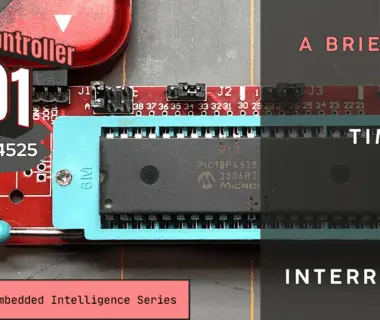
Microcontroller-101 Section 2 PIC18F4525 Featured Image
Electronics

Microcontroller 101: A Brief on GPIO, Timers, ADC, PWM, and Interrupts (PIC18F4525)

Reading Time: 50 minutesIntroduction In Part 5, of the Circuit Component Super Series, we introduced microcontrollers as the control layer — the decision-making core that transforms simple circuits into intelligent systems. Now it’s time to go deeper and understand how it works internally. This article breaks down the fundamental building blocks you’ll encounter in nearly every microcontroller project: […]

Dustin Hodges 
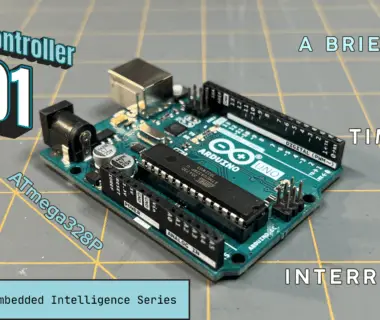
Microcontroller 101: A Brief on GPIO, Timers, ADC, PWM, and Interrupts (ATmega328P)
Electronics

Microcontroller 101: A Brief on GPIO, Timers, ADC, PWM, and Interrupts (ATmega328P)

Reading Time: 29 minutesIntroduction In Part 5, of the Circuit Component Super Series, we introduced microcontrollers as the control layer — the decision-making core that transforms simple circuits into intelligent systems. Now it’s time to go deeper and understand how it works internally. This article breaks down the fundamental building blocks you’ll encounter in nearly every microcontroller project: […]

Dustin Hodges 
Electronics

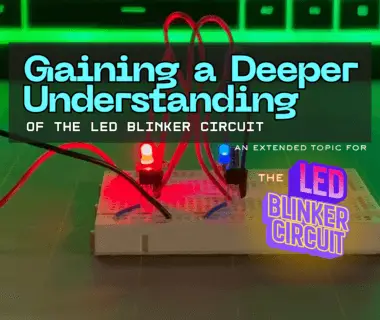
Gaining a Deeper Understanding of the LED Blinker Circuit (An Extended Topic for the LED Blinker Circuit)

Reading Time: 23 minutesIntroduction The following content is intended to be a companion to the LED blinker circuit we created from our article titled, “How Components Work Together in Real Circuits.” The sole purpose of this discussion is to work as an extended topic for that article to help you understand your circuit better, to help clarify what’s […]

Dustin Hodges 
Electronics

Questions Answered on the Blinker Circuit (An Extended Topic for the LED Blinker Circuit)

Reading Time: 17 minutesIntroduction The following content is intended to be a companion to the LED blinker circuit we created from our article titled, “How Components Work Together in Real Circuits.” The sole purpose of this discussion is to work as an extended topic for that article to help you understand your circuit better, to help clarify what’s […]

Dustin Hodges 
Electronics

What Exactly Is an Astable Multivibrator? (An Extended Topic for the LED Blinker Circuit)

Reading Time: 15 minutesIntroduction The following content is intended to be a companion to the LED blinker circuit we created from our article titled, “How Components Work Together in Real Circuits.” The sole purpose of this discussion is to work as an extended topic for that article to help you understand your circuit better, and to help clarify […]

Dustin Hodges 
Electronics

Understanding Circuit Symbols and Schematics: The Road Maps of Electronics

Reading Time: 12 minutesIntroduction The following is Part 2, of a planned 12 part super series on the topic of components. We started with what components are – now we’re moving onto the topic of circuit component symbols and schematics. Later, we’ll progressively work through more topics and ideas of components, further advancing these ideas into a robot […]

Dustin Hodges 
Motbots